


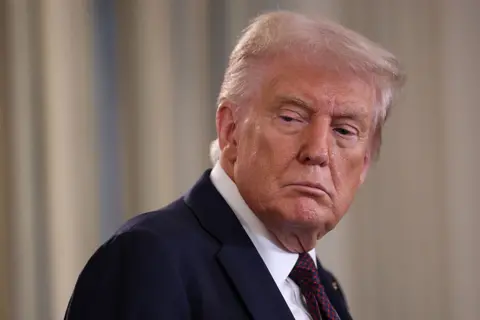
America's highest court starts its new term on Monday featuring an docket already packed with likely important cases that might determine the scope of Donald Trump's presidential authority – along with the possibility of more issues to come.
Over the past several months following Trump was reelected to the White House, he has pushed the limits of presidential authority, solely enacting new policies, reducing federal budgets and staff, and attempting to put formerly independent agencies more directly under his control.
Judicial Conflicts Over National Guard Deployment
The latest emerging judicial dispute stems from the administration's moves to seize authority over local military forces and send them in urban areas where he alleges there is public unrest and rampant crime – against the resistance of regional authorities.
Across Oregon, a federal judge has delivered orders blocking the administration's deployment of troops to the city. An appeals court is preparing to examine the move in the next few days.
"We live in a country of constitutional law, rather than martial law," Judge Karin Immergut, who the administration appointed to the judiciary in his first term, declared in her recent statement.
"The administration have presented a series of arguments that, should they prevail, endanger weakening the distinction between civilian and armed forces federal power – to the detriment of this republic."
Shadow Docket Might Determine Troop Power
When the appeals court makes its decision, the justices might get involved via its referred to as "shadow docket", handing down a ruling that may limit executive ability to employ the troops on US soil – or grant him a broad authority, in the short term.
These processes have become a increasingly common practice lately, as a larger part of the court members, in reaction to urgent requests from the White House, has mostly allowed the government's policies to continue while court cases unfold.
"A tug of war between the High Court and the trial courts is poised to become a driving force in the upcoming session," a legal scholar, a academic at the prestigious institution, stated at a meeting recently.
Concerns Regarding Shadow Docket
Judicial use on this emergency process has been questioned by left-leaning academics and officials as an improper exercise of the legal oversight. Its rulings have typically been short, providing minimal explanations and leaving behind trial court judges with scarce instruction.
"Every citizen must be alarmed by the High Court's growing dependence on its expedited process to settle controversial and high-profile matters without any form of transparency – no substantive explanations, oral arguments, or justification," Politician Cory Booker of New Jersey commented in recent months.
"It additionally drives the justices' deliberations and decisions out of view public oversight and shields it from responsibility."
Comprehensive Reviews Coming
Over the next term, however, the court is preparing to confront questions of governmental control – as well as further notable disputes – squarely, hearing public debates and providing full decisions on their substance.
"It's unable to get away with short decisions that don't explain the reasoning," stated Maya Sen, a professor at the prestigious institution who studies the High Court and US politics. "If the justices are going to grant greater authority to the executive the court is will need to clarify why."
Significant Matters within the Docket
Judicial body is currently planned to consider the question of government regulations that prohibits the president from removing personnel of bodies designed by the legislature to be autonomous from presidential influence violate executive authority.
The justices will further consider appeals in an accelerated proceeding of the administration's bid to dismiss Lisa Cook from her position as a official on the prominent Federal Reserve Board – a dispute that could significantly increase the president's power over American economic policy.
America's – and global economic system – is additionally a key focus as Supreme Court justices will have a occasion to determine whether several of the President's solely introduced duties on international goods have sufficient statutory basis or should be overturned.
Court members may also examine the President's moves to solely reduce public funds and dismiss junior public servants, as well as his assertive immigration and removal measures.
Even though the justices has yet to agreed to examine the administration's bid to terminate automatic citizenship for those given birth on {US soil|American territory|domestic grounds


